0 comments

Revision for the final test

Hi class,

Here you have the contents for the final Use of English exam:


Remember you have grammr explanations in Edmodo and at the end of the workbook (pages 95-105)

Vocabulary Unit 9
Grammar:
-to be / have got
-there is/are - there was/were
-personal pronouns and  possessive adjectives (my/your/its/his/her/our/your/their)
-comparative adjectives and superlative adjectives *
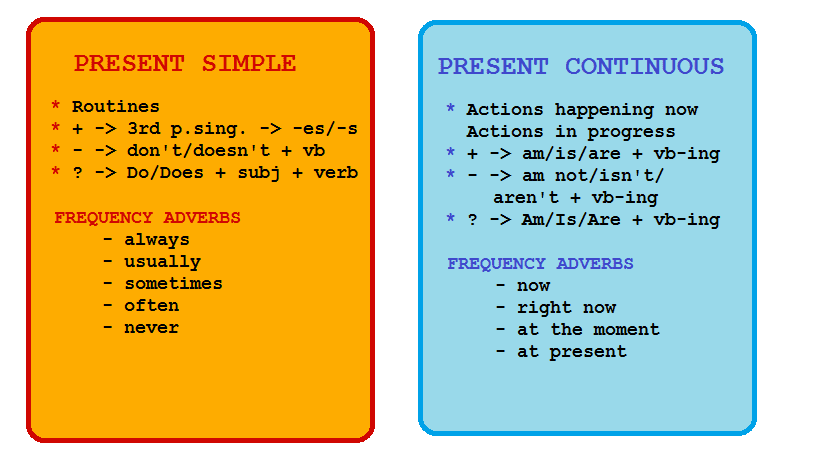
-Present Simple vs Present Continuous
-Past Simple vs Past Continuous
-Future: will and be going to + verb
-First Conditional (If + present simple, WILL + verb) *
-Present Perfect
-Modal verbs (can/could/must/musn't/should/have to/need to)

Remember revising the Irregular verbs!


Ok, now it is time to practise for next week test:

1.Look at the photos and do the exercises.

    to be / have got

    to be exercises

    have got exercises 


2. Look at the photos and do the exercise.

    there is/are - there was /were


3. Look at the photo and do the exercise.

   personal pronouns and possessive adjectives (my/your/its/his/her/our/your/their)


4. Look at the photos and do the exercises.

    Present Simple vs Present Continuous (contrast)

    Present Simple exercises

    Present Continuous exercises


5. Look at the photos and do the exercises.

    Past Simple vs Past Continuous: easy and average (contrast)

    Past Simple exercises

    Past Continuous exercises

    At HOME you can practise in HERE.


6. Look at the photos and do the exercises.

    Future: will and be going to + verb


7. Look at the photo and do the exercises.

   First Conditional (If + present simple, WILL + verb)


8. Look at the photo and do the exercise.

    Present Perfect


9. Modal verbs (can/could/must/musn't/should/have to/need to)
    Can/could
    Must / mustn't
    Should


10. Look at the photos and do the exercises.

     Comparative adjectives and superlative adjectives


and soon...


read more
0 comments

Present Perfect: Sentences to translate


PRESENT PERFECT

Take the theory with you (from your notebook or WB. page 102,103)
Remember you have the Unit 7 and 8 vocabulary in the WB page 87, 88
You can check the Irregular verbs at the end of the WB (pages 107,108)

A.Complete​ the following sentences using the Present Perfect​.
1-You (eat) the apple? _______________________________
2-She (make) (not) a mistake__________________________
3-He (run) for two miles._______________________________
4-They (learn) a lesson._______________________________
5-Harry (write) a letter to Ron.___________________________
6-Edward (sell) his car.________________________________
7-The children (fight) (not)today._________________________
8-We(drink) the water?________________________________
9-It(run) home._______________________________________
10-You (read) a book._________________________________

B.Translate​ the following sentences using the Present Perfect​.
1-Jo no he remat.____________________________________
2-Ell ha granat.______________________________________
3-En Toni ha batut el rècord___________________________
4-Ha arribat n’Enric?__________________________________
5-Na Maria s’ha estirat damunt la tovallola
________________________________________________
6-En Josep no ha esqueixat (esquinçar) el paper
__________________________________________________
7-Les teves amigues han comprat menjar porqueria?
___________________________________________________
8-Hem perdut pes____________________________________
9-El meu ca no ha agafat la llesca_______________________
10-Elles han enganxat aquest poster._____________________
11-En Pere no ha posat la taula._________________________
12-Vosaltres heu pagat l’entrenador?_____________________
13-El sol ha brillat tot el dia_____________________________
14-Na Joana t’ha enviat un email.________________________
15-En Sebastià i na Mercè han doblegat la roba
___________________________________________________
16-N’Ernest no ha triat aquest menjar processat
___________________________________________________
17-Després del accident el meu moix no ha sagnat.
____________________________________________________
18-Heu caigut a la pista?________________________________
19-He penjat la medalla________________________________
20-El ca de na Martina ha amagat l’os
___________________________________________________

C.Translate these sentences using already​ ("ja" in affirmative sentences​)
1-Ja he vist a na Carolina cara a cara.____________________
2-Na Sonia ja ha cuinat la truita__________________________
3-Ja he sentit que has donat de menjar a un animal salvatge
__________________________________________________
4-En Llorenç ja ha anat a l’estranger_____________________
5-Els bombers ja han apagat el foc______________________

D.Translate these sentences using yet​ ("encara" in negative sentences)
1-Encara no he llegit la dieta equilibrada
___________________________________________________
2-L’ou encara no ha esclatat.____________________________
3-Encara no he fet els deures.___________________________
4-El bebé encara no hem engreixat.______________________
5-El protagonista encara no ha tornat boig.
___________________________________________________
6-Encara no hem vist a l’artista___________________________

E.Translate these sentences using yet​ ("ja" in interrogative sentences)
1-El meu germà petit ja ha dit mentides?
________________________________________________
2-La teva tia ja ha participat al carnaval?
_________________________________________________
3-Els teus amics ja han anat a classes de defensa personal?
_________________________________________________
4-Avui ja has begut massa cafeïna?_____________________
5-El nostre equip ja ha contraatacat?____________________
6-En Julià encara no ha anat de creuer___________________

F. Complete the following sentences with FOR or SINCE.
1-I haven't phoned home ……………………... Christmas.
2-We've been here ………………………. nine o'clock.
3-I have worked for International House ……………... more than eight years.
4-I haven't visited my home town …………………. I left school.
5-I haven't been to the cinema ………... ages. 6-I have studied non-stop ……….. 9.15.
7-I have had a driving licence ……………. I was eighteen.
8-Peter has been my best friend………... we were nine.

G.Translate these sentences using for ​or since.
1-He corregut durant 45 minuts:____________________________
2-Nosaltres estudiat des de les 6:___________________________
4-Ell ha dormit durant 12 hores:_____________________________
5-Hem anat de viatge durant 10 dies:________________________
6-Ha plogut durant una setmana:____________________________
7-He viscut a Inca des de que tenia 5 anys:____________________
8.No he vist en Gerard des de el seu aniversari:_________________


read more
0 comments

Homework for this Wednesday May 10th

Homework for Wednesday May 10th: 
WB. page 57 and
Translate these 10 sentences: (use the workbook to have a look at the vocabulary and irregular verbs)

B.Translate​ the following sentences using the Present Perfect​.
1-Jo no he remat.
2-Ell ha granat.
3-En Toni ha batut el rècord
4-Ha arribat n’Enric?
5-Na Maria s’ha estirat damunt la tovallola
6-En Josep no ha esqueixat (esquinçar) el paper
7-Les teves amigues han comprat menjar porqueria?
8-Hem perdut pes
9-El meu ca no ha agafat la llesca
10-Elles han enganxat aquest poster.
read more
0 comments

Travelling bloggers

Hi guys,

Today you are going to visit a travelling blog and discover the life of travelling bloggers.

Answer the following questions. Look for the information here on this link.

1. Write the name of the blog.

2. Go at the end of the page and write the name of the last POST of the page:

3. Stay on the last post of the page and click on READ MORE. What happens?

4. Stay on the post.
    What is the first post about? The first post they wrote, so it is the last of the page on the last page.
    Note that the last post they wrote appears as the first on the blog.

    a) What did they write?
    b) What is the image showing?

5. c) What does this mean Share with your friends .... ?
   d) How can you do it?

6. e) What does this mean Date Created:  ?
    
    f) and this Update:  ?

7. Go on reading. What are the comments  ?  And the Reply button?
 
8. Go back (make sure you are on page 27 - you can see it at the bottom) and have a look to the post      "What a day we dreamt".

   g) What happened here?

9. What does the date below the photo mean?

10. Go at the top of the page. These are PAGES.


     Discuss with your partner: What can each page refer to?

11. Watch the video you find at the top right part of the blog. Enjoy it!

12. Have a look to their Around the world trip by clicking on other pages (do it at the bottom of the page). DON'T go to the first ones as they are not about this trip. Visit pages 25, 20, 17, etc but not the first ones!!!)

13. So, what is the difference of a blog and a webpage? We will discuss it the whole class together.

14. What is a travelling blogger? We'll all talk about it.


read more
0 comments

The FUTURE and 1st Conditional


Hi guys,

Today we are going to revise 3 different ways to talk about the future:

- A. WILL (Future Simple)

- B. BE (am/is/are) GOING TO +  verb

- C. BE (am/is/are) + verb in ING (Present Continuous)


Let's go for it!


A. In English there is a magical word (an auxiliary verb) that turns the verb into the FUTURE.
Remember it:


Affirmative form: Subject +  WILL + verb
                                                                      ('ll)
Negative form: Subject +  WILL NOT + verb
                                                                (won't)
              Interrogative form: (QW) + WILL + Subject + verb ?


Click on the exercises to practise the Future Simple:exercise 1, exercise 2, exercise 3 and exercise 4


B. There is another way to form the future: BE GOING TO + VERB. 
       Read the following photo and do the activities you will find below the image.


Affirmative form: Subject +  is / are / am going to + verb
                                                                      
Negative form: Subject +  isn't / aren't / am not going to  + verb
                                                               
Interrogative: (QW) + is / are / am + Subject + going to + V ?


Click on the exercises to practise the be going to + verb structure: exercise 1, exercise 2, exercise 3 and exercise 4.


C. There is a third way to form the future: using the PRESENT CONTINUOUS.
       Read the following photo and do the activities you will find below the image.


Click on the exercises to practise the Present Continuous with future meaning: exercise 1, exercise 2 and exercise 3.


D. First CONDITIONAL SENTENCE


Se forma amb IF + simple present + simple future (WILL). 
S'utilitza quan una situació és real o possible. 
Ex: If it rains today, I'll stay at home 
            Pres.S              Future
      Si avui plou, quedaré a casa.
                     Pres.S     Future

Utilitzam el primer condicional per xerrar d'una possibilitat real en el futur, és a dir, d'una acció que és possible que ocorri en el futur sempre i quan es cumpleixi una condició.  

Per exemple:
Imaginem que una amiga me va demanar que demà l'ajudés per estudiar un examen que farà aquesta setmana, jo no sé si la podré ajudar demà perquè he de fer moltes coses.
  • If I have time tomorrow, I will help you. (Si tenc temps demà, t'ajudaré)
  • TIP: La frase també pot tenir el IF al mig de la frase. Sempre a la dreta del IF posarem el Present
I will help you If I have time tomorrow (T'ajudaré si tenc temps demà. )


Look at more examples:
  • If we don't hurry, we'll miss our bus.
    Si no feim via, perdrem el nostre autobús.
  • If he is busy now, I will come back tomorrow.
  • Si està ocupat, tornaré demà.
  • If I have time, I'll visit my parents this afternoon.
    Si tenc temps, visitaré els meus pares avui horabaixa.
  • If it is warm tomorrow, we'll go to the beach.
    Si demà fa bona temperatura, anirem a la platja.


read more